Data labeling is where many AI projects slow down
Computer-vision models do not learn from a folder of images alone. They need examples that say what matters: where an object begins and ends, which pixels belong to a region, or which point marks an event or condition.
That work usually falls to someone who understands the subject. The engineer knows which component is damaged. The agronomist knows which leaf pattern matters. The field team knows which object should be separated from background noise. Traditional labeling tools still ask that person to repeat the same manual action across hundreds or thousands of images.
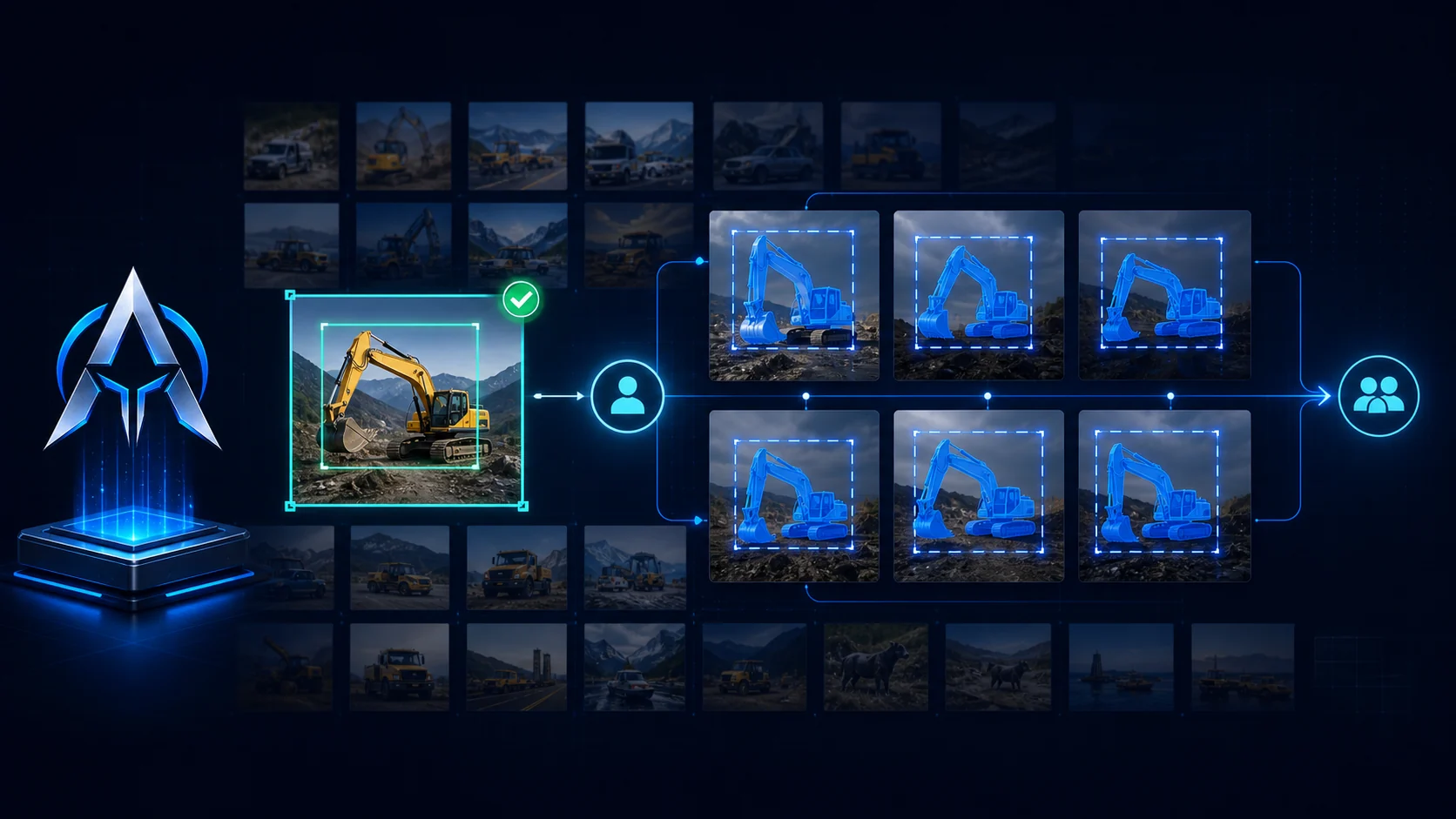
Athena is built around a more useful division of labour: the human teaches the intent, and AI handles the repetitive first draft.
Label one, then review the rest
The core Athena workflow is intentionally simple:
- Upload an image set.
- Draw one bounding box, paint one mask, or place one point.
- Let Athena draft related labels across the remaining images.
- Review the suggestions it is confident about and focus attention on the uncertain cases.
- Correct, reject, or undo any proposed label before it becomes part of the dataset.
This is assisted labeling, not unattended labeling. Athena does not remove the person who understands the problem. It gives that person leverage while keeping approval and correction visible.
Three annotation styles for different questions
Different models need different kinds of ground truth. Athena supports the common visual annotation patterns without asking the operator to think like a machine-learning engineer.
Bounding boxes
Boxes answer where is the object? They are useful when a model needs to locate and count distinct items in an image. A reviewer draws a rectangle around the target, then checks Athena's proposed boxes on related images.
Segmentation masks
Masks answer which pixels belong to it? They preserve the shape of a region instead of reducing it to a rectangle. This is useful when boundaries, surface coverage, or irregular shapes matter.
Point labels
Points answer where did the event occur? They are a lightweight option when an exact location matters more than a full outline. They can also provide a fast starting signal before a richer annotation is required.
The interface keeps these decisions visual. The operator teaches by pointing, drawing, and reviewing rather than by writing scripts.
Human review remains the quality gate
An AI suggestion is not automatically ground truth. Similar lighting, repeated backgrounds, partial objects, occlusion, and rare edge cases can all produce plausible-looking mistakes.
Athena keeps a human review loop between model-drafted labels and a versioned dataset. Suggested annotations can be accepted, edited, or rejected. Uncertain cases are surfaced for attention. Every label remains reversible.
That distinction matters: automation should reduce repeated work without hiding uncertainty or weakening accountability.
From reviewed labels to a reproducible dataset
Labeling is only useful when the resulting dataset can be understood and reproduced later. Athena connects annotation to the rest of the data workflow:
- Dataset versioning freezes source files, labels, train/validation splits, and settings into a named version.
- Preprocessing previews make operations such as resize, tiling, grayscale conversion, and normalization visible before training.
- Train-only augmentation creates controlled variations for training while keeping evaluation data separate.
- Exportable data prevents the labeling work from being trapped inside one platform.
The result is more than a collection of annotation files. It is a traceable dataset state that a team can review, compare, and use again.
No-code labeling first, model training next
Athena extends beyond annotation into no-code model training, evaluation, and export. That broader pipeline is valuable, but it begins with the labeling experience: help the person with domain knowledge create trustworthy examples faster.
Once a reviewed dataset is ready, teams can move into supported training approaches, evaluate on held-out data, inspect explanations, and prepare approved outputs for deployment. The downstream model remains only as credible as the data and review decisions that produced it.
Who Athena is for
Athena is designed for teams where the person who understands the problem is not necessarily the person who writes training code:
- Domain experts defining what should be detected or segmented.
- Operations teams organizing field imagery.
- AI teams that need consistent review and dataset versioning.
- Companies that want data and outputs to remain exportable.
- Clients reviewing shared project results without learning a developer toolchain.
The product goal is straightforward: make expert judgment easier to scale without pretending that expert judgment is optional.
The practical promise
Athena's data-labeling proposition is not that AI should decide everything. It is that a person should not have to redraw the same obvious label endlessly.
You provide the example. Athena drafts the repetition. You keep control of what becomes training data.