An auto-label is a guess
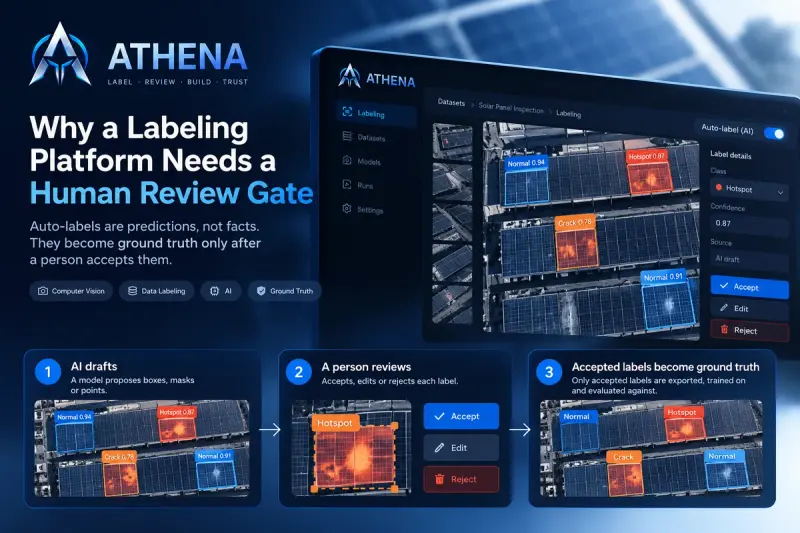
Auto-labeling is the most useful shortcut in building computer-vision datasets. A model proposes the boxes, masks or points, and a person no longer redraws the same obvious label across hundreds of images.
But a proposed label is a prediction. It has the same status as any other model output: usually right, sometimes confidently wrong, and unable to tell you which is which by looking at it. Ground truth is different. Ground truth is the reference answer that a model is trained and measured against, and its value comes from being independent of the model.
That difference is the whole argument for a human review gate: auto-labels count as ground truth only after a person accepts them.
What goes wrong without a gate
If drafted labels flow straight into the dataset, three problems follow.
Errors become training data
A box that is slightly off the object, a mask that bleeds into the background, or a missed partial object is written into the dataset as if it were correct. The next model trains on it and learns the same mistake.
The model grades its own homework
If the model that drafted a label is later evaluated on that label, agreement tells you nothing. The score measures how well the model matches itself, not how well it matches reality. Held-out evaluation is only meaningful when the reference labels came from a person.
Plausible mistakes hide well
Machine-drafted errors are rarely obvious. Similar lighting, repeated backgrounds, occlusion and rare edge cases tend to produce labels that look reasonable at a glance. These are the errors a person catches in seconds when asked to look, and nobody catches when nobody is asked.
What a review gate actually is
A gate is not a vague promise that "humans are in the loop." It is a concrete boundary in the data model and the interface.
- Draft: a label proposed by a model. It is visible, but it is not part of the dataset.
- Accepted: a label a person has approved, either as drafted or after editing. This is ground truth.
- Rejected: a label a person has discarded. It stays out of the dataset.
The important rule is that these states never blur. A draft must not be exported, counted, trained on or evaluated against as though it were accepted. Anything that reads from the dataset should see accepted labels only.
A gate has to be cheap, or people will skip it
A review step that is slow gets bypassed. The gate works when the cost of reviewing is far below the cost of labeling from scratch:
- Accepting is one action. Most drafts are right, so the common case should take the least effort.
- Editing is in place. Nudging a box edge is faster than deleting and redrawing it.
- Uncertain cases are surfaced. Reviewer attention goes first to the labels the model is least sure about, not spread evenly.
- Every decision is reversible. If a reviewer accepts something by mistake, undoing it should be as easy as the original click.
This is the same division of labour behind Athena's label-one, review-the-rest workflow: a person teaches the intent with one example, AI drafts the repetition, and the person decides what gets kept. The Athena assisted-labeling article covers that workflow in detail.
Why it matters downstream
The gate pays off wherever the dataset is used later.
- Reproducibility. A dataset version that contains accepted labels only can be frozen, compared and re-used, and every label in it traces to a human decision.
- Honest evaluation. Validation and test splits built from accepted labels measure a model against independent references.
- Accountability. When a deployed model behaves badly, a team can trace the cause back through the dataset to specific labels and the people who approved them, instead of discovering that the training data was itself machine-generated.
- Trust. Domain experts, clients and auditors can accept a model's output more readily when they know people reviewed the data behind it.
"But doesn't review defeat the point of automation?"
No. Automation removes repetition, not judgment. The slow, error-prone part of labeling is drawing the same obvious shape again and again, and that part should be automated. The part that needs someone who understands the problem is deciding whether a label is correct, and that part should not be.
A good gate shifts the person's job from drawing to deciding, which is faster, and keeps the dataset honest.
Frequently asked questions
What is a human review gate in data labeling?
It is the step where a person accepts, edits or rejects AI-drafted labels. Only accepted labels are treated as ground truth and allowed into a dataset version.
Why can't auto-labels be treated as ground truth directly?
Because they are model predictions. They can be confidently wrong, and if they are used as reference labels, the next model learns those errors and evaluation against them no longer measures real accuracy.
Does review make auto-labeling pointless?
No. The model still does the repetitive drafting; the person only decides. Reviewing a draft is much quicker than creating a label from scratch, especially when uncertain cases are surfaced first.
What should a review gate guarantee?
Drafts, accepted labels and rejected labels stay distinct. Exports, training and evaluation read accepted labels only. Every decision can be undone.
How does Athena handle this?
Athena treats AI suggestions as drafts. People accept, edit or reject them, uncertain cases are surfaced for attention, and every label remains reversible before it becomes part of a versioned dataset. See Athena OS for the open-source audio and image labeling platform.
The short version
Let the model draft. Let a person decide. A label becomes ground truth at the moment someone accepts it, and not before.
If you are building or choosing a labeling platform, ask one question first: can an unreviewed machine label end up in my training set? If the answer is yes, you do not have ground truth yet. To see the review workflow in practice, explore Athena.